
Book of Oz Technical Overview
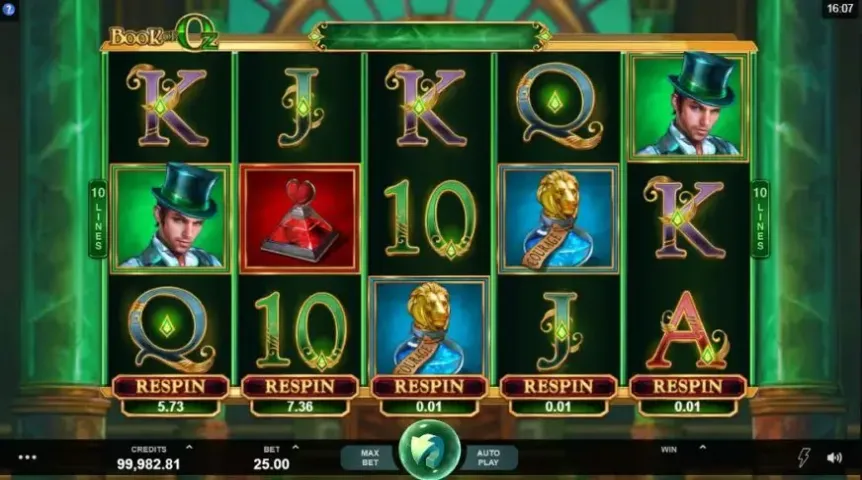
Developed by Triple Edge Studios in collaboration with Microgaming, Book of Oz utilises a standard 5x3 reel configuration with 10 fixed paylines. The primary mechanical differentiator is the Reel Respin feature, which permits players to respin individual reels indefinitely for a calculated cost following any base spin. This Hyperspins-style mechanic allows for strategic manipulation of the grid to force bonus triggers or complete high-value paylines.
The betting range supports a wide demographic, typically spanning from £0.10 to £25.00, though some operators may engage a cap of £100.00. While the interface appears traditional, the underlying engine supports high variance gameplay, necessitating strict bankroll management. The integration of the respin mechanic into the base game offers a level of agency rarely seen in standard 'Book' clones.
Maths: RTP, Volatility and Win Potential
The return to player (RTP) for Book of Oz is variable, with configurations generally observed at 96.31% or 96.50%. This places the title slightly above the industry aggregate, provided one engages with the favourable setting. The volatility is categorised as high, implying a lower frequency of wins but a distribution skewing towards significant payouts during bonus rounds. Players should anticipate periods of stagnation typical of high-variance mathematical models.
The theoretical maximum exposure is capped at 5,000x the total stake. While single-line wins contribute significantly to the payout profile, the cumulative potential is heavily reliant on the Free Spins feature and expanding symbols filling the screen. The Reel Respin costs are dynamically calculated based on the probability of completing a winning combination, meaning the cost-to-respin ratio increases proportionally with the potential payout.
Book of Oz Payout Structure
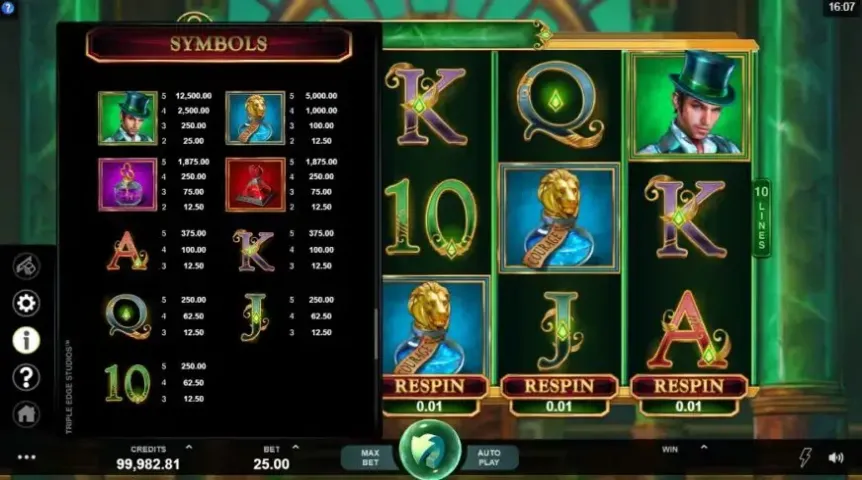
The paytable comprises ten symbols, split between low-value royals and high-value thematic premiums. The lower tier consists of 10, J, Q, K, and A, with five-of-a-kind combinations awarding between 5x and 7.5x the stake. The premium tier features three potions-Courage (Cyan), Heart (Red), and Key (Blue)-alongside the Wizard entity. Payouts for premiums rise sharply, with the Courage potion awarding 100x for a full line.
The Wizard represents the highest value in the base table, awarding 250x the total stake for five on a payline. The titular Book symbol serves a dual function as both Wild and Scatter, substituting for regular symbols and paying up to 200x for five instances. Uniquely, premiums payout for as few as two consecutive symbols, whereas royals require a minimum of three.
Bonus Mechanics and Respins
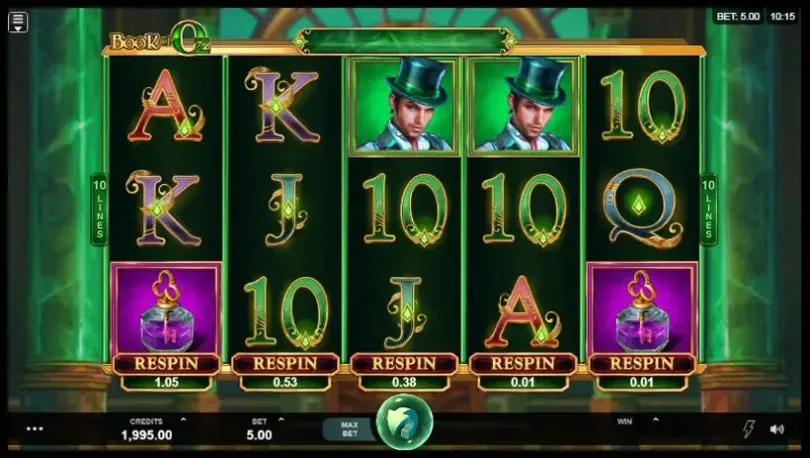
The core base game innovation is the Reel Respin. After a spin concludes, players can pay to respin a single reel while others remain locked. The cost is displayed at the bottom of each reel. This is strictly a paid mechanic, allowing players to target missed scatters or high-paying 5-of-a-kind lines. Costs can exceed the initial spin stake significantly when the probability of a high win is imminent.
The Free Spins bonus is triggered by landing 3, 4, or 5 Book scatters, awarding 10, 12, or 25 spins respectively. Consistent with the genre, a special Expanding Symbol is randomly selected at the onset. This symbol expands to cover the entire reel when landing and pays on non-adjacent positions (scatter-style) across active paylines. Retriggers are possible, extending the session and increasing the probability of hitting the 5,000x cap via full-screen expansions.
Although Book of Oz follows the established 'Book' slot formula, the integration of the respin option alters the strategic approach. It allows players willing to pay a premium to effectively purchase second chances at triggering the main bonus round, a tactical variation absent in predecessors like Book of Ra.
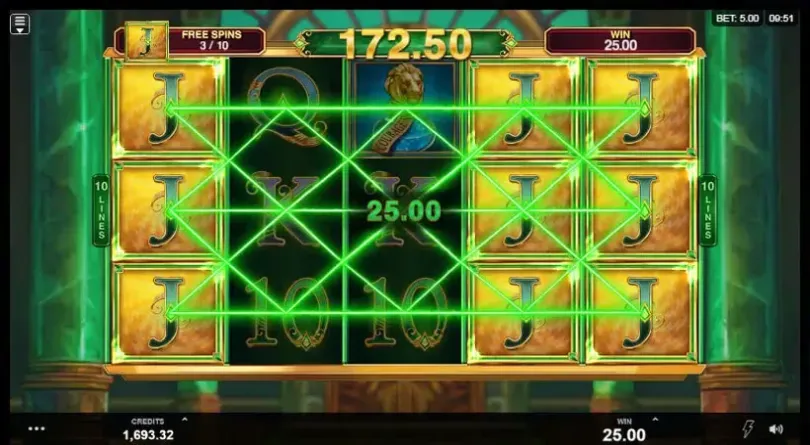
In-Game Screenshots


Book of Oz FAQ
Book of Oz — Comparison
| Game | RTP | Volatility | Max Win | Rating |
|---|---|---|---|---|
| 96% | High | x5000 | ||
| 96.5% | High | x5000 | 8 | |
| 96.51% | Low | x2833 | 6 | |
| 95.29% | Average | x2400 | 7 | |
| 96.37% | Average | x1333 | 7 | |
| 96.20% | Average | x2500 | 9.5 | |
| 96.37% | 95.49% | 94.02% | 92.05% | High | x6833 | 5 | |
| 96.12% | High | x500 | 5 | |
| 96.32% | High | x13000 | 7 | |
| 96.45% | 94.01% | 92.05% | High | x5000 | 7 | |
| 96.41% | High | x2500 | 7 | |
| 96.32% | High | x1000 | 7 | |
| 96.41% | High | x1100 | 7 | |
| 96.03% | High | x1000 | 5 | |
| 96.1% | Average | x1000 | 6 | |
| 96.5% | Average | x570 | 6 | |
| 96.31% | Average | x10000 | 6 | |
| 96.40% | Average | x5000 | 6 | |
| 96.26% | Average | x2000 | 5 | |
| 96.19% | High | x3800 | ||
| 96.12% | High | x25000 | ||
| 92.03% | Average | x500 | ||
| 96.22% | High | x25000 | ||
| 96.12% | High | x10000 | ||
| 96.12% | High | x2.219 | ||
| 95.72% | High | x10000 | ||
| 96.50% | High | x5000 | 8 | |
| 96.40% | High | x10000 | 6 | |
| 96.6% | High | x5000 |