

Treasures of Lion City Mechanics and Setup
Developed by Pulse 8 Studios, Treasures of Lion City utilises a standard 5x3 reel configuration with 25 fixed paylines. Released in December 2019, the technical framework relies heavily on the Rolling Reels™ engine, an analogue to the Avalanche mechanics found in similar grid slots. Winning symbols are removed from the matrix, allowing new variables to drop in and potentially form consecutive combinations within a single spin cycle.
The gameplay loop is described as simple and direct, avoiding complex scatter-triggered sub-games in favour of on-reel modifications. While specific RTP and volatility data points are not populated in the provided dataset for this specific title, the mechanics suggest a model driven by streak variance. The primary variable is the cascade sequence itself, which gates the game's modified states and higher payout tiers behind consecutive successful grid clears.

Symbol Logic and Rolling Reels™ Transformations
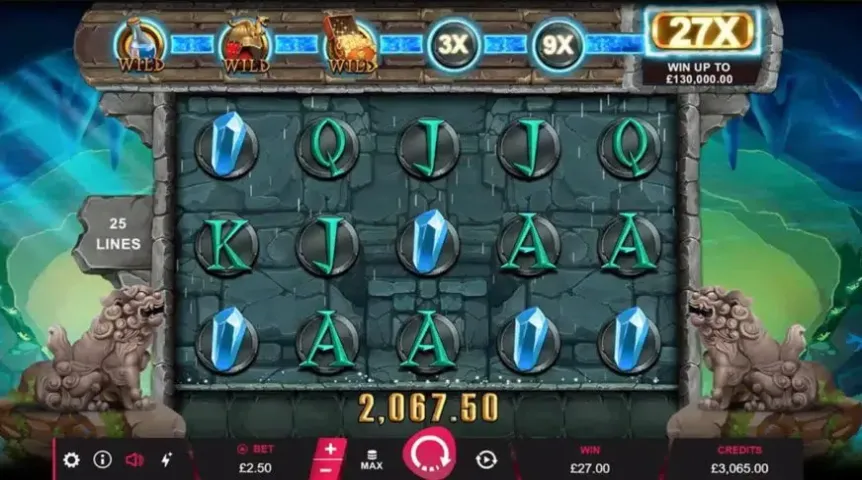
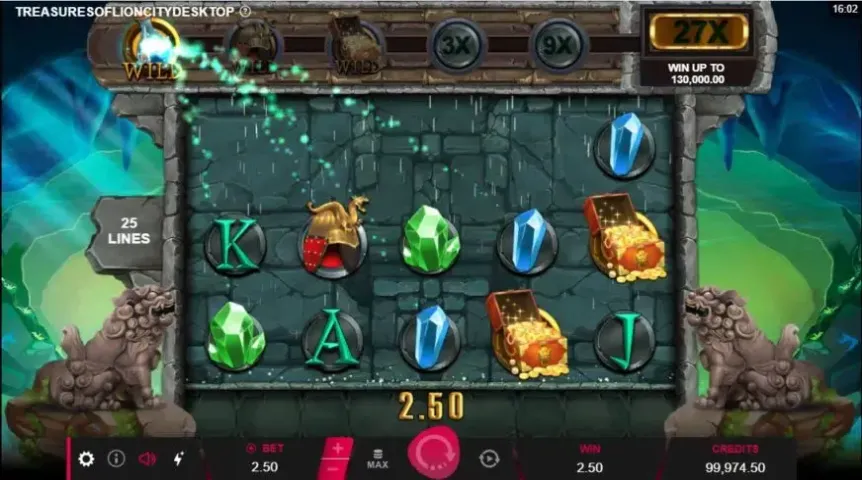
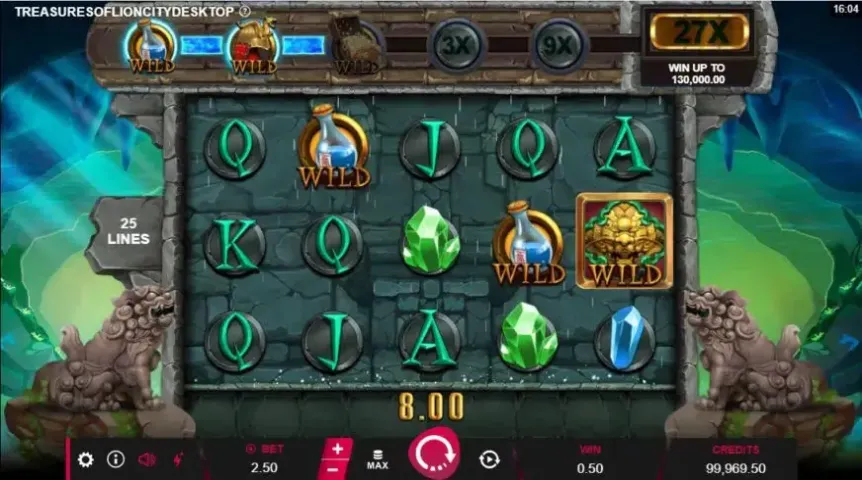
The payout structure is dynamic, shifting active parameters based on the specific odd-numbered level of the cascade. The Rolling Reels™ feature systematically alters the symbol weightings by converting high-paying premiums into Wilds. On the first cascade level, the high-value Elixir Symbol transforms into a Wild, immediately increasing the density of substitute symbols available for the next calculation.
Sustaining the win sequence to the third level grants the Wild property to the Helmet Symbol, followed by the Chest Symbol at the fifth cascade. This tiered transformation mechanic effectively lowers the symbol pool variance as the streak continues. By progressively converting distinct premium symbols into generic substitutes, the system reduces the probability of 'dead' blocks.
Mathematically, this feedback loop serves to facilitate extended play. As the player advances through the cascade levels, the probability of connecting paylines increases due to the higher concentration of Wilds. This structural logic is designed to propel the player towards the final mathematical stages of the feature, where the win multiplier is applied.
Multiplier Progression and Win Capping
The game's maximum yield potential is tied to a multiplier accumulation system which activates exclusively at the seventh cascade level. Upon reaching this threshold, a base multiplier of x3 is applied to the winnings, introducing a significant scalar to the paytable values. This delayed activation indicates a back-loaded payout distribution, requiring deep progression into the Rolling Reels™ sequence to access substantial returns.
Continued cascades at this stage can elevate the multiplier to a maximum cap of x27. This exponential growth curve suggests that the statistical bulk of the win potential is reserved for these rare, high-count cascade events. For the analytical player, the value proposition of Treasures of Lion City lies entirely in the frequency of reaching these upper-tier multiplier levels.
Treasures of Lion City Symbols and Paytable
| Symbol | Payout |
|---|---|
 | Wild |
| 5 → x20 | |
| 4 → x3 | |
| 3 → x0.8 | |
| 2 → x0.4 | |
 | 5 → x18 |
| 4 → x3 | |
| 3 → x0.8 | |
 | 5 → x15 |
| 4 → x2.4 | |
| 3 → x0.6 | |
 | 5 → x12 |
| 4 → x2.4 | |
| 3 → x0.6 | |
 | 5 → x11 |
| 4 → x2 | |
| 3 → x0.6 | |
 | 5 → x6 |
| 4 → x1.4 | |
| 3 → x0.4 | |
 | 5 → x5 |
| 4 → x1.2 | |
| 3 → x0.4 | |
 | 5 → x2 |
| 4 → x1 | |
| 3 → x0.4 | |
 | 5 → x4 |
| 4 → x1 | |
| 3 → x0.2 | |
 | 5 → x4 |
| 4 → x1 | |
| 3 → x0.2 |
In-Game Screenshots
Treasures of Lion City FAQ
Treasures of Lion City — Comparison
| Game | RTP | Volatility | Max Win | Rating |
|---|---|---|---|---|
| 94.20% | Average | x2500 | 10 | |
| 94.40% | High | x3133 | 6.5 | |
| 96.47% | High | x3000 | 4 | |
| 96.24% | Average | x2000 | 7 | |
| 97.15% | High | x1000 | ||
| 96.05% | High | x7300 | 7 | |
| 96.19% | High | x7290 | ||
| 96.19% | Average | x2400 | ||
| 96.52% | High | x14000 | ||
| 95.22% | High | x2100 | 6 | |
| 96.14% | Average | x1000 | 7 | |
| 96.5% | High | x4500 | 6 | |
| 95.12% | 94.13% | 92% | Low | x10000 | 7.3 | |
| 96.9% | Average | x10000 | 7 | |
| 95.72% | High | x10000 | ||
| 96.92% | Average | x2000 | ||
| 96.04% | High | x12000 | ||
| 96.44% | Average | x1000 | ||
| 96.14% | Average | x1000 | 7 | |
| 96.12% | Average | x5000 | 6 | |
| 96.14% | Average | x1000 | 6 | |
| 92.08% | Average | x500 | 7 | |
| 96.2% | Average | x2000 | ||
| 94.8% | High | x7150 | 5 | |
| 96.03% | Average | x357 | 5 | |
| 95.72% | Average | x10400 | 6.5 | |
| 96.20% | High | x22640 | 7 |